









What Are RFID Chips?
- 7/11/26 | Asked by Sam O.
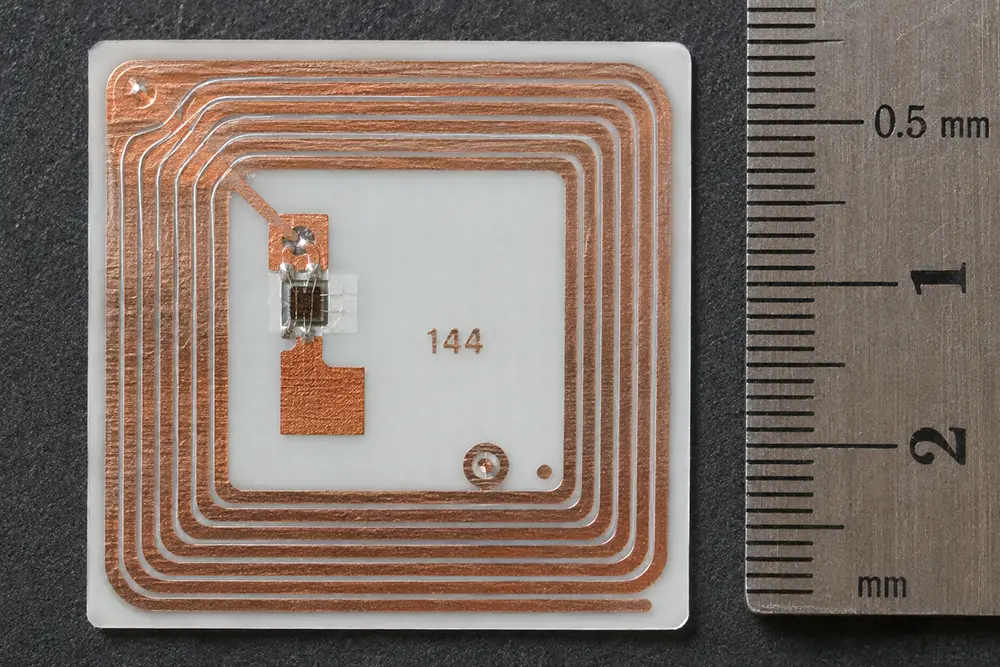
RFID chips are small electronic components used in radio frequency identification (RFID) tags to store and transmit identifying data. When combined with an antenna, the chip allows an RFID tag to communicate wirelessly with an RFID reader.
RFID chips are used throughout manufacturing, warehousing, retail, logistics, healthcare, asset management, and other industries to identify and track physical objects. Unlike traditional barcodes, RFID tags can often be read without direct line of sight, making it possible to automatically identify many tagged items as they move through a facility or supply chain.
Quick Answer: What Is an RFID Chip?
An RFID chip is a small integrated circuit inside an RFID tag that stores identifying information and communicates that information through radio waves. The chip works together with an antenna to receive signals from an RFID reader and return stored data. In passive RFID systems, the tag does not require a battery; energy from the reader's radio-frequency field powers the chip long enough for it to respond. RFID chips are commonly used to identify and track products, inventory, assets, equipment, pallets, containers, and other physical objects.
What Does an RFID Chip Do?
An RFID chip stores information that can be transmitted to an RFID reader. Depending on the RFID system and chip, this might include a unique identifier, Electronic Product Code (EPC), product information, serial number, or other application-specific data.
In a typical supply chain application, the information stored on the chip allows software to associate an RFID tag with a specific product or asset. When that tag is detected, the RFID system can record events such as when and where the item was seen.
How Do RFID Chips Work?
An RFID system generally consists of an RFID tag, antenna, reader, and software.
With passive RFID, the reader generates an RF field. When a compatible RFID tag enters that field, its antenna captures energy from the signal and supplies power to the RFID chip. The chip processes the reader's command and communicates information back by modulating or "backscattering" the radio signal.
The RFID reader captures that response and passes the information to software, where it can be used to identify the item, update inventory, record a movement, trigger an alert, or perform another automated action.
Is an RFID chip the same thing as an RFID tag?
Not exactly.
The RFID chip is the integrated circuit responsible for storing and processing information. An RFID tag is the complete RFID device attached to an object.
A typical RFID tag contains:
- RFID chip – stores and processes information
- Antenna – receives and transmits RF signals
- Substrate or inlay – holds the chip and antenna together
- Protective material or label – depending on the tag's intended application
RFID tags can take many forms, ranging from thin adhesive labels attached to retail products to rugged tags designed for industrial equipment.
What Information is Stored on an RFID Chip?
The amount and type of information depends on the RFID chip and application.
For example, RAIN RFID tags commonly contain several logical memory areas. These can include EPC memory, which can hold the Electronic Product Code identifying the object; TID memory, which contains information about the RFID chip itself; Reserved memory, which can contain access and kill passwords; and, on supported tags, User memory for additional application data.
Many RFID applications don't need to store large amounts of information directly on the tag. Instead, the RFID chip contains a unique identifier that software uses to retrieve additional information from a database.
How Much Data Can an RFID Chip Store?
It varies considerably.
Some simple RFID tags may contain little more than a 96- or 128-bit unique identifier. Higher-memory RFID tags can store considerably more information. GS1 notes that RAIN RFID tag capacity depends on the chip and application and that some high-memory passive UHF tags can store up to 8 KB.
For many supply chain applications, however, the objective isn't to put an entire product record on the RFID chip. A unique identifier can connect the physical item with much richer information maintained in an enterprise database.
What is an EPC on an RFID chip?
EPC stands for Electronic Product Code. It provides a standardized method for uniquely identifying physical objects and can be encoded into an RFID tag.
For example, an EPC can be derived from a serialized Global Trade Item Number (SGTIN), allowing individual instances of the same product to be uniquely identified rather than identifying only the product type.
Importantly, EPC and RFID aren't the same thing. An EPC is identification data; an RFID tag is one type of data carrier capable of storing and communicating that identifier.
Can RFID Chips be Rewritten?
Many RFID chips contain memory that can be rewritten, although this depends on the tag and how its memory has been configured.
An RFID tag's EPC or user memory may be writable, allowing information to be encoded or updated. Memory can also be locked to prevent unauthorized or accidental changes.
TID memory is different. It typically contains information programmed by the chip manufacturer and is generally permanently locked rather than being rewritten by the end user.
Can RFID Chips be Rewritten?
Many RFID chips contain memory that can be rewritten, although this depends on the tag and how its memory has been configured.
An RFID tag's EPC or user memory may be writable, allowing information to be encoded or updated. Memory can also be locked to prevent unauthorized or accidental changes.
TID memory is different. It typically contains information programmed by the chip manufacturer and is generally permanently locked rather than being rewritten by the end user.
How are RFID Chips Encoded?
RFID encoding is the process of writing information to the memory of an RFID tag.
In a supply chain environment, an RFID printer/encoder may print a human-readable label and barcode while simultaneously encoding information onto the RFID chip embedded within the label.
RFID encoding software determines what information should be written to the tag and converts it into the appropriate format. GS1's EPC Tag Data Standard, for example, defines how EPCs and other information are represented on RAIN RFID tags.
What are RFID Chips Used For?
RFID chip technology supports a wide range of applications, including inventory management, asset tracking, warehouse automation, work-in-process tracking, shipping verification, receiving, cycle counting, returnable container tracking, tool tracking, retail inventory, and supply chain traceability.
The underlying concept is similar across these applications: give a physical object a unique digital identity and automatically capture that identity as the object moves through the real world.
How Does RFID Software Work With RFID Chips?
The chip is only one part of an RFID solution.
RFID readers generate raw tag reads, but businesses need software to determine what those reads mean. RFID software can associate tag IDs with products and assets, filter duplicate or unwanted reads, apply business rules, update enterprise systems, create alerts, and maintain a history of RFID events.
For example, CYBRA's Edgefinity IoT RFID platform can use RFID data to support applications such as inventory visibility, asset tracking, work-in-process tracking, and automated movement monitoring.
CYBRA's MarkMagic barcode and RFID labeling software can be used to design RFID labels and encode RFID data as part of the printing process.
Together, RFID chips, tags, readers, printers, antennas, and software create an infrastructure capable of connecting physical items with digital business systems.
Ready to Explore RFID?
Ready to move beyond one-at-a-time scanning? Talk to CYBRA about scaling RFID across your operation. Our team can help you evaluate read performance, design a pilot, and build a rollout plan that fits your environment.